PETROSLEEVE is classified as a Type A sleeve. But is it, really?
PETROSLEEVE technically sits within the pipeline industry’s Type A sleeve classification – but its speed and simplicity of installation, engineering pedigree and permanent repair credentials put it well beyond what that category was ever designed to describe.
Ask most pipeline engineers to picture a Type A repair sleeve and they’ll picture something modest: a reinforcement fitted around a non-leaking defect, doing a useful but limited job, with no pressure-containing capability and no expectation of permanence. It’s the entry-level classification in a system built around welded steel sleeves.
PETROSLEEVE® fits inside that classification. It also does a great deal more than that classification was built to capture – which raises the question: is “Type A” the right category for PETROSLEEVE?
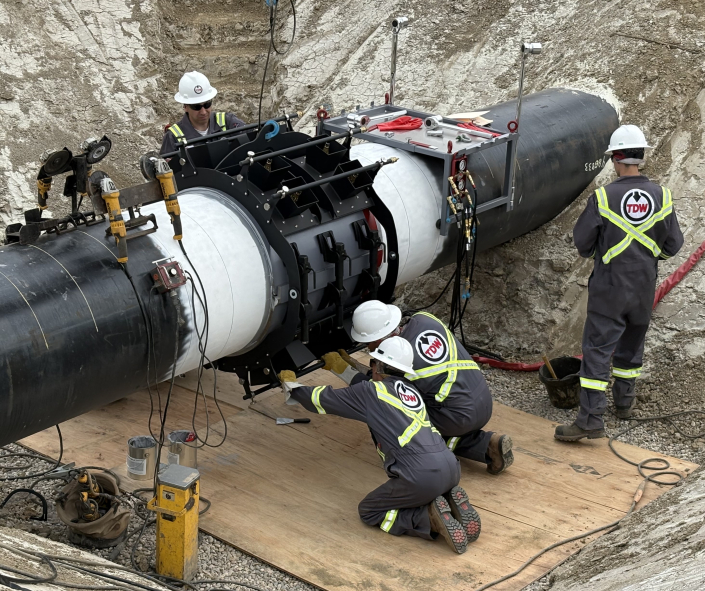
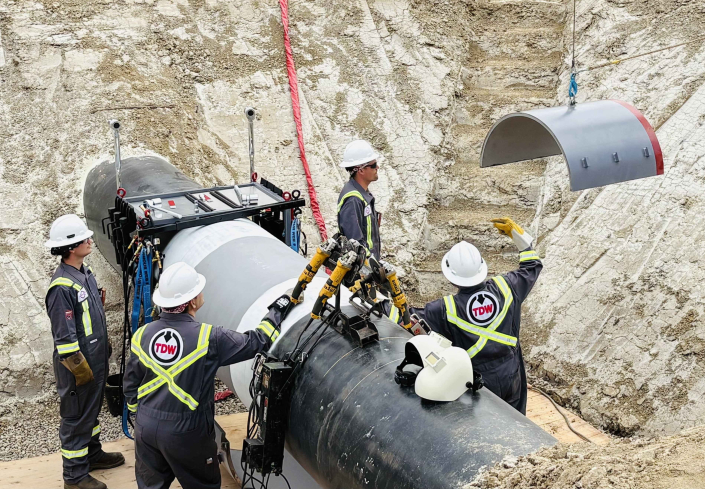
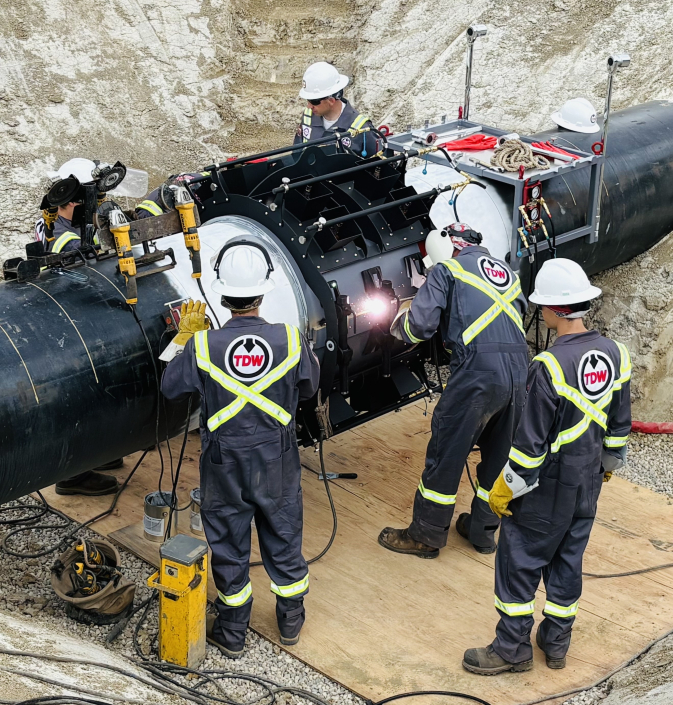
For pipeline operators, that’s more than an academic question. The single biggest reason operators choose PETROSLEEVE is speed and simplicity: a typical installation takes a couple of hours, not days, without taking the pipeline out of service or bringing in a welding crew.
A different kind of sleeve
Traditional pipeline repair sleeve categories – Type A (reinforcement only) and Type B (welded, pressure-containing) – were developed around welded steel technology.
PETROSLEEVE, developed in the 1990s as a steel compression repair system, works on a different principle: rather than welding a shell onto the pipe to contain pressure, it applies controlled compression to the carrier pipe itself. This reduces hoop stress at the defect and arrests further defect growth without welding to the pipe or taking the system out of service.
This mechanical difference is why PETROSLEEVE doesn’t map neatly into a classification system designed for welded technology. It meets the Type A requirements, but it also restores serviceability in a way more associated with permanent, pressure-restoring repairs.
This has led to the PETROSLEEVE team coining the term “Type C” to highlight that it works on a fundamentally different mechanism to other repair methods.
| Feature | Type A sleeve | Type B sleeve | PETROSLEEVE (“Type C”) |
| Attachment to carrier pipe | Not welded to pipe; longitudinal seam only (mechanical or welded) | Fully welded to pipe, including circumferential end welds | Not welded to pipe; two-part sleeve joined by external mechanical compression, without hot-work or in-service welding |
| Pressure containment | Not designed to contain pressure | Fully pressure-containing | Reduces hoop stress at the defect by compressing the carrier pipe; not currently classified as “pressure-containing” under every code |
| Defect types suited | Non-leaking defects: external corrosion, dents, gouges | Leaking or through-wall defects, including cracks | Corrosion, denting, gouging and cracking (incl. SCC) – leaking or non-leaking |
| Hot work / in-service welding to pipe required | No | Yes | No |
| Typical installation time | Hours, depending on defect and prep | Longer – welding procedures, hot-work permits and qualified welders required | Roughly one hour to a couple of hours |
| Independent long-term testing | Standard reinforcement testing under applicable code | Standard weld/pressure testing under applicable code | CANMET cyclic pressure testing (2000/2002, simulating ~150 years of pressure history); C-FER JIP (2023) axial reinforcement testing; ongoing PETROSLEEVE leak testing |
| Current code recognition | Well-established under ASME B31.4/B31.8, API 1104, AS2885 | Well-established under ASME B31.4/B31.8, API 1104, AS2885 | Classified as Type A; “Type C” recognition sought with PRCI and ASME – not yet formally adopted by any code |
Where certification currently stands
The proof: two decades of independent testing
In 2000, PETROSLEEVE underwent an extreme cyclic pressure testing program conducted by CANMET, an independent Canadian government research body. PETROSLEEVE was installed on sections of 1950s-era ERW pipe with severe pre-existing defects, including a 70% through-wall slot and a 50% through-wall fatigue crack.
The pipe was subjected to 36,500 pressure cycles, simulating 100 years of daily pipeline shutdowns (on top of pipe that had already seen roughly 50 years of service).
The program was designed to force a catastrophic failure. The 1950s-era ERW pipe was notorious for low Charpy impact values and a high susceptibility to seam cracking. The aim of the independent testing body was to demonstrate how PETROSLEEVE would perform under worst-case pipeline conditions
The results of the test were conclusive. There were no failures, no crack extension, no cracking in the fillet welds, and no measurable relaxation of PETROSLEEVE’s clamping force over time. The defects were permanently arrested, and the test demonstrated that PETROSLEEVE could permanently restore the pipe’s serviceability.
More recently, a multi-phase Joint Industry Project run by C-FER Technologies – and supported by pipeline operators ATCO, Pembina Pipeline Corporation and Trans Mountain – independently tested six non-welded repair systems for circumferential crack repair.
The aim of the project was to find out if non-welded systems could safely restore a pipe’s ability to withstand severe longitudinal pulling forces without leaking or rupturing. This would provide an alternative to the traditional repairs for circumferential cracks which require the disruption of cutting out the section of pipe or the operational risks associated with installing a heavy, welded Type B sleeve.
Out of the repair methods tested, PETROSLEEVE came out on top, providing 22–40% more axial reinforcement than the next-best system under elastic loading, and 32–35% higher average (76–146% higher peak) reinforcement under plastic loading. Within the C-FER study, PETROSLEEVE was also the only system to show reinforcement clearly outside the margin of measurement variation across every test conducted.
PETROSLEEVE’s own decades-long leak testing program remains ongoing, continuing to build on this body of independent evidence.
Is PETROSLEEVE a Type A sleeve, or can I use it for permanent repair?
PETROSLEEVE does what a Type A sleeve is expected to do. It also delivers pressure-restoring, permanent repair performance backed by independent, third-party testing spanning more than two decades. It is installed in a fraction of the time of many alternative repair methods, without welding to the pipe.
The classification conversation will continue to evolve as certification efforts progress across PRCI, B31.4, B31.8 and beyond. In the meantime, the existing performance data speaks for itself.
Tremco Pipeline Equipment is the exclusive distributor of PETROSLEEVE across Australia, New Zealand, PNG and the Pacific Islands. For more information, contact Brett Trembath and the team at sales@tremcopipeline.com.au
